Wednesday, June 20, 2012

Designer Diary 5: Melee Combat in Space Hulk: XT

Ah, melee. The sweet sound of Terminator armor crunching and tearing beneath the claws of eager young Genestealers. What is it, though, that makes hand-to-hand combat in Space Hulk work? What makes it tick? How can it be expanded to include more models from the 40K universe in a consistent and fun manner?

First off, a few basic parameters:
-All models in Space Hulk begin with a 1d6-2 melee attack.
-Close assault score is modified by weapons used.
-Close assault score is further modified by a model’s seniority (squad leader, hero, etc.)

This may seem slightly off to those of you who are new to the Space Hulk extended rules set from First Edition. However, here are a few examples to help make sense of things.
-Genestealer Hybrids/Brood Brothers have a close assault factor of 1d6-2, modified by weapons.
-Power-armoured Tactical Marines have a close assault factor of 1d6-2, Sergeants 1d6-1.
-A Hybrid armed with a Power Sword gains +2 to melee, for a net of 1d6.
-Therefore, a Tactical Marine Sergeant with a Power Sword would also gain +2 to melee, for a net of 1d6+1. This is the same as a Terminator Sergeant with a Power Sword.

Any 40K players out there are probably twitching right now reading this, mumbling things like “armour saves” and “terminator honors, plus one attack.” This brings a rather profound basic element of gameplay to the fore: Space Hulk is not directly analogous to 40K. Sure, Terminator armour confers an amazing saving throw in 40K while a brood brother wouldn’t even get a save against a Power Fist. However, Space Hulk isn’t about open battlefields: it’s about fighting in tight, tense, claustrophobic hallways, so close that you can spit on the enemy. What one model loses in heavy armor it will make up for with mobility and a better ability to take cover. The only real time armor comes into play in Space Hulk is when shooting.

In close assault in 40K, a huge number of factors have to be taken into account. Weapon Skill (yours and the opponents), Strength, Toughness, Initiative, Attacks, Wounds, Armour Save and weapon types all have their place. Abstracting this to Space Hulk’s single opposed die roll does make for some differences, but remember that this is a very specific type of battlefield. Any vets out there will tell you that modern warfare, room clearing MOUT-style is rather different than the battlefields of WWII.

So now we have established the first set of basics for close combat. How then do things like Lightning Claws (2d6+2) and Purestrain Genestealers (3d6) fit into the picture? The existing progression of modifiers for melee looks something like this:

-1d6-2: model with basic weapon
-1d6-1: model with pistol or close combat weapon
-1d6: model with power weapons OR two pistols/close combat weapons
-1d6+1: model with power weapon and pistol/close combat weapon
-1d6+2: model with Thunder Hammer/Storm Shield
-2d6+2: model with lightning claws
-3d6: Purestrain Genestealer

This information gives us plenty to work with. Several elements stand out here. Firstly, specialized, trained close combat models have bonuses to their die rolls regardless of the number of dice rolled (Hammer/Shield at 1d6+2 and Claws at 2d6+2). Secondly, only models with more than one weapon roll more than one die, assuming they have a high enough overall modifier (Claws at 2d6+2 and Purestrains at 3d6). With this in mind, I have here for your viewing pleasure a reverse-engineered list of melee weapon modifiers.

Weapon Name             CC Modifier
Pistol or CCW                       1
Power Weapon                     2
Lightning Claw (each)           3
Thunder Hammer                  3
Storm Shield                          1

Now, apply this to a model’s base of 1d6-2. If a model’s bonus goes above certain thresholds, it will need to roll more dice with a lower bonus as shown below. Again, bear in mind that specialized, trained models will have a higher bonus rather than extra dice, and only models with more than one weapon will roll extra dice.

Melee Modifiers
1d6-2
1d6-1
1d6
1d6+1
1d6+2 OR 2d6
1d6+3 OR 2d6+1
1d6+4 OR 2d6+2 OR 3d6

So, a base model (1d6-2) with a Thunder Hammer (+3) and Storm Shield (+1) will have a net melee modifier of 1d6+2. This could be converted to 2d6, but since it is a melee specialist with only one weapon it instead goes with the 1d6+2 option.

A model (1d6-2) armed with two Lightning Claws (+3/+3) would net 1d6+4 in melee. This is converted over to 2d6+2, since the model has two melee weapons but is elite.

Counting a Genestealer’s Rending Claws as being the same as a pair of Lightning Claws, we again have 1d6-2+3+3, for a total of 1d6+4. Since a Genestealer has multiple attacks but is not trained (just ferocious), this is converted to the highest number of dice possible without giving it a positive modifier. In this case, we end up with 3d6.

As you can see, this design for close combat modifiers fits existing models perfectly well as long as a bit of logic and certain rules are applied. How well does it stand up to expanding the game into Space Hulk: XT, though?

Tune in this Friday to find out, as I explore new models in close combat and special rules for melee weapons.

-M

Monday, June 18, 2012

Designer Diary 4: What to view as (Assault) Cannon in Space Hulk: XT?


Before delving into melee, I feel I must first touch on another topic: what parts of Space Hulk do I view as core elements of the game? Now, while I will be going more in depth in the near future looking at each of the previous editions and many of the supplements, for the time I will summarize it here, so that I may get back to the discussion of close assault on Wednesday.

First Edition Space Hulk was masterfully done, and elegant in its simplicity. Death Wing added more variety by way of missions and Space Marine weapons without really adding difficulty. Finally, Genestealer added Hybrids, which brought an interesting new element to the game, but also helped to balance it. However, the expanded psychic rules introduced slowed down and muddied gameplay.

First Edition extras from White Dwarf generally ended up in new expansions, and in general were high quality. The real exception here was the campaign in WD 158, which made Space Wolf terminators somehow more badass than all others, giving them 5 AP and +1 to melee. Reminds me of a time when a certain 40K race got entirely eaten by Tyranids because of favoritism and internal politicking…

First Edition articles appearing in the Citadel Journal were another matter. These were obviously playtested sparingly, and written more for the sake of having content then expanding the game in a balanced manner. While some interesting elements were added, the fact that anything remotely resembling point values or a way to use these new models in the game regularly were not included again showcased this rather well.

Second Edition took a simple but effective game and dummed it down for marketing purposes. White Dwarf supplements attempting to re-introduce Deathwing weapons in Second Edition is a perfect example of how poorly this worked. A number of nifty new missions were added throughout its lifespan, however, as well as the simple yet clever rules for using air ducts.

Third Edition in many ways went back to the classic rules of First Edition. Some simple changes were made that were not necessary but made the game simpler for new Marine players, such as jamming/unjamming on overwatch, sustained fire, and line of sight. Other minor tweaks were also made for no apparent reason that interfered with using the full rules set of First Edition, such as Guard and the rules for wounding a Broodlord. However, while most of the changes made were either unneeded or unbalancing, the updated take on psychic rules was decidedly well done, even if only used by the Space Marines.

So, in summary, I view (in general) the following elements as being the core foundation of Space Hulk: XT.
First Edition, Deathwing, Genestealer (minus the psychic cards) and the majority of White Dwarf content, as well as a rare few selected elements from Citadel Journal (such as the effect of using a power axe).
Second Edition Terminator models, because they’re easy to make stop-motion movies with.
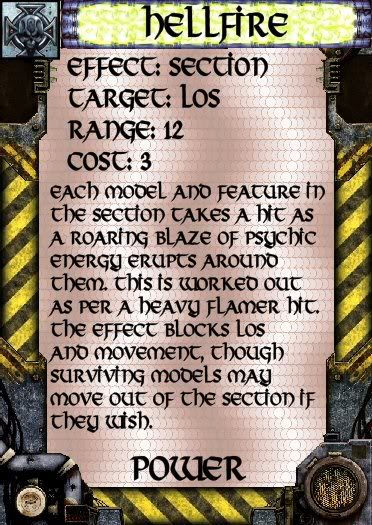
The basic elements presented in Third Edition for psychic rules (which I have already put a good deal of work into expanding, as seen by the Hellfire card below).


As I stated, I will be addressing each Edition separately and in greater depth in the future. However, if you have any questions or comments about my brief synopsis above, please feel free to ask and I shall elaborate further.

-M

Wednesday: Melee combat. No, for real this time!

Friday, June 15, 2012

Designer Diary: Dealing Damage in Space Hulk: XT


The first element of Space Hulk that drew my attention to its need of a revision was dealing combat damage. Admittedly, it is not difficult to remember that a Storm Bolter achieves a kill on a 6, the Assault Cannon on a 5+, and the Heavy Flamer on a 2+. In any edition, as far as the basic game is concerned, combat is relatively simple and straightforward. This very quickly becomes more convoluted as extra rules and expansions are added, however.

The core of Space Hulk first edition was designed around Genestealers, Terminators and Terminator Sergeants. Basic rules, and done, with no need for messing around. This worked admirably well, forming a core of simple gameplay that powered a smooth, squad-based tactical game. But then came new weapons… and new units for them to shoot at. Soon, this handful of numbers grew and expanded into page-long spreadsheets that had to be updated on a regular basis with every addition of new rules or weapons. To top this off, some of these official spreadsheets had editing errors. What had once been perfectly adequate groundwork for Space Hulk’s combat no longer fit the needs of the game as it should have.

This may sound familiar to you. Any old D&D players out there? Here’s a hint: THAC0. It worked perfectly well for a time, back when armor went from light (10) to heavy (0). As D&D grew, more items were added, and soon you had to deal with heavy, magical armor that went all the way down to -10. While there is nothing wrong with having to subtract a negative modifier from a die roll, it is not needed, either. All it did was make the game a bit more cumbersome. And so, with a slight update, Armor Class became an entirely positive number, that simply went up with enhancement. Same odds to hit, easy to convert from one to the other, but much more sensible for the direction the game had taken.

This is essentially what I have done in Space Hulk: XT for ranged combat. In first edition, you would need to view a chart to see that a Storm Bolter needs to roll a 6 to kill a Terminator, a 5 for a Tactical Marine, and a 4 to kill a Genestealer Hybrid. Every weapon you wanted to fire would be similar to this process. Instead of this, in Space Hulk: XT every model is assigned a Toughness value. When attempting to shoot a model, you will roll dice as determined by your weapon, add any modifiers, and compare it against the target’s toughness. Should you equal or exceed this value, you have scored a successful hit. So firing a Storm Bolter (2d6 attack, +0 damage) you would need to equal or beat a Terminator’s Toughness of 6, a Tac Marine’s 5, or a Hybrid’s 4. This means that the core gameplay will remain unchanged: the terminology applied just gets simpler.

Very few values do not fit within this altered rules structure. What few do not are weapons seldom used, or against targets that only rarely make an appearance (i.e. extremely specific things like an Autocannon fired against a marine at a range of 12 squares or less). As a tradeoff for these few differences that affect gameplay only slightly, the addition of new weapons and units becomes much simpler. Rather than adding a new unit and having to decide how each different weapon will affect it, one may simply assign an appropriate Toughness value based on the weapons already present in the game.

In summary: instead of looking at a chart to determine how a certain weapon will affect a certain model (on a Tuesday, if the sun is out, and you are wearing blue), you roll a die, add your weapon’s damage, and compare it to the target’s toughness. And done!

-M

Coming on Monday: the conundrum of melee combat.

Wednesday, June 13, 2012

Designer Diary: Action Cards in Space Hulk: XT


Many games over the years have utilized some form of Action/Event/Fog of War deck to simulate the vagaries of chance on the battlefield. These have appeared in Space Hulk style games as far back as Space Crusade, up to the more modern Claustrophobia and Incursion board games. A number of table-top wargames have also begun to include similar mechanics. While not something everybody enjoys, many players do take enjoyment in the extra level of randomness and uncertainty provided. As such, one of the first elements I wanted to build into Space Hulk: XT was an optional action card deck.

Easier said than done.

There is one notable issue with most games that use action cards that made translation to Space Hulk rather more difficult than I first had imagined. Most games that include action cards of any sort are in fact driven by their inclusion, not simply enhanced. Although Incursion draws very, very heavily from Space Hulk for its core rules, anyone who has played more than a few games will be able to tell you that the back-and-forth interplay between cards is an enormous part of gameplay. This is not in and of itself a bad thing: however, I wanted to layer an additional level on to Space Hulk, not add in a new element that completely controlled the outcome of the game.

Thus, I was faced with a conundrum. The only real reference material available to me from similar games sported a power curve much more dramatic than what I was seeking. So, I began with simple conversions from similar games, and very quickly pared down to elements that were less drastic.

As an example, cards with effects like “Target model is immediately shot by an auto-defense turret, 1d6 +0 damage” went right out. In mission #1, Suicide Mission, playing this card gives the Genestealer player one chance in six to win the mission outright. No matter how well the Marine player maneuvers, no matter how lucky he is up to that point, one simple card could very well end the game. This goes against the feel that Space Hulk’s well-crafted gameplay evokes: tight, tense, claustrophobic, and always balancing on a knife’s edge of victory and defeat. But removing many of the cards to preserve game balance brought up another question: how much should a single, lucky card draw affect the game?

My answer is this: A lucky card draw should in general affect a situation no more than a lucky Command Point draw, or a lucky die roll, or luck blip draw.

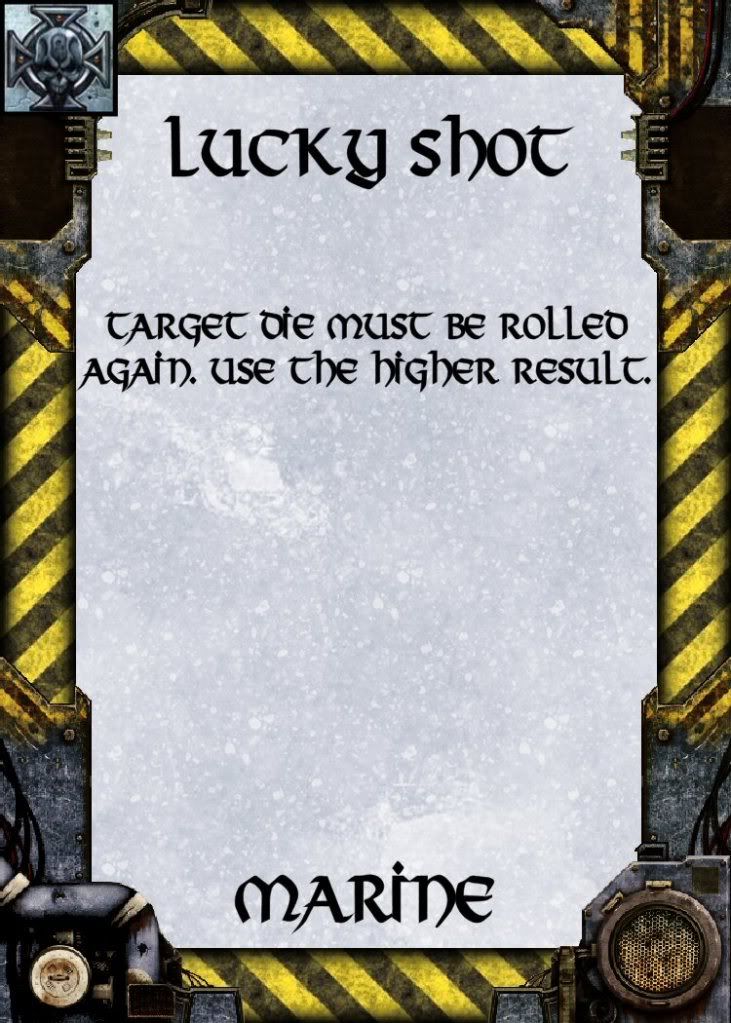
With this in mind, the cards being used (that had already undergone many tweaks and revisions by this point) were scrutinized again. This is done in a number of different ways. For example, the fairly straightforward “Lucky Shot” card allows for a chance to roll a die again and use the higher of the two results. This card is available to both players, and is no more powerful than a lucky roll in the first place.


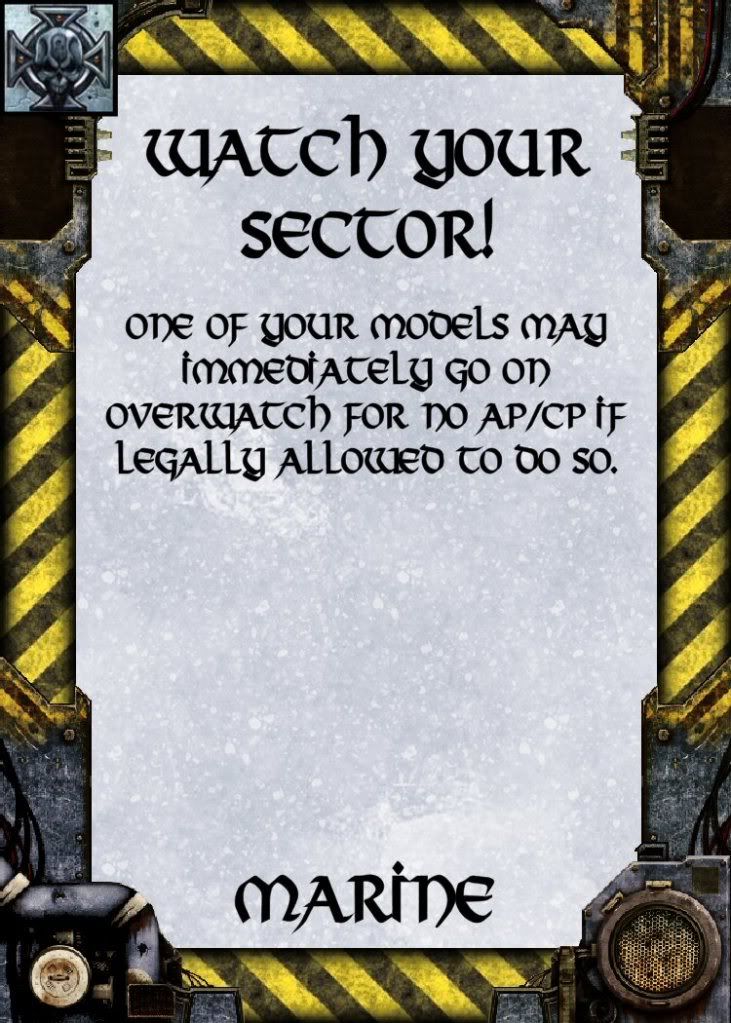
In a similar fashion, the Marine-based order card “Watch Your Sector!” allows a model to go on overwatch if legally allowed to do so. While this may be surprising if used and timed correctly, it is in and of itself not all that different from drawing a few extra CP.


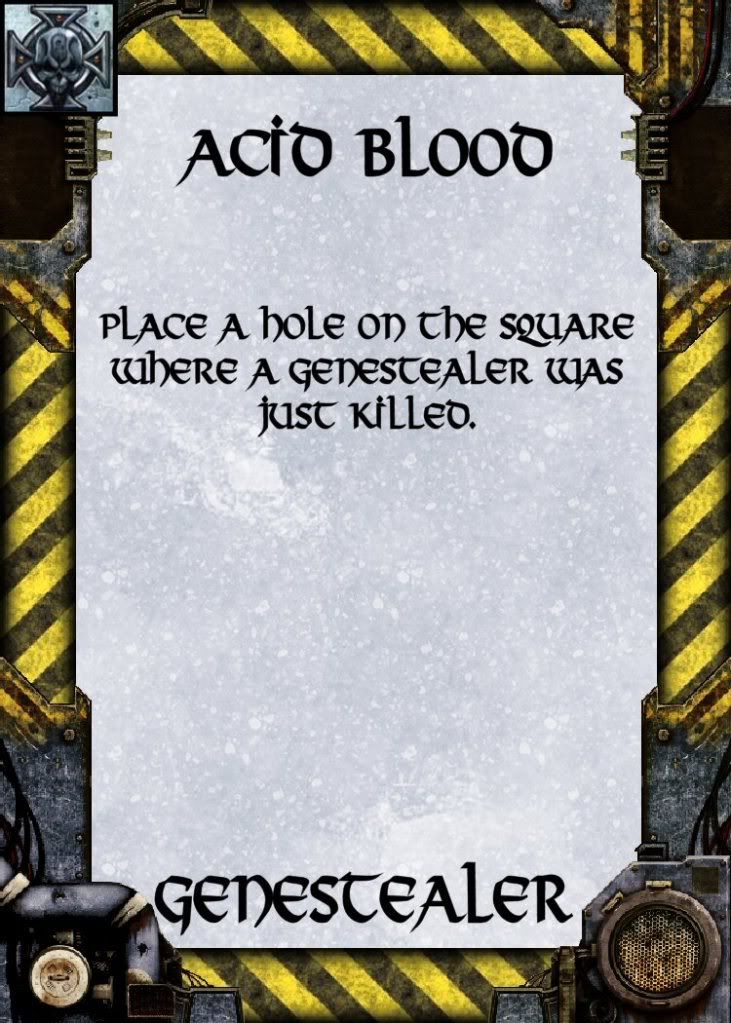
Many of the cards, however, do diverge somewhat from this fairly simple extrapolation. The Genestealer card “Acid Blood” places a hole in the ground where a ‘stealer was just killed. Again, not game breaking (and in some situations, not even all that relevant), but placed in the right area in the right missions it can certainly make a Marine player sweat.


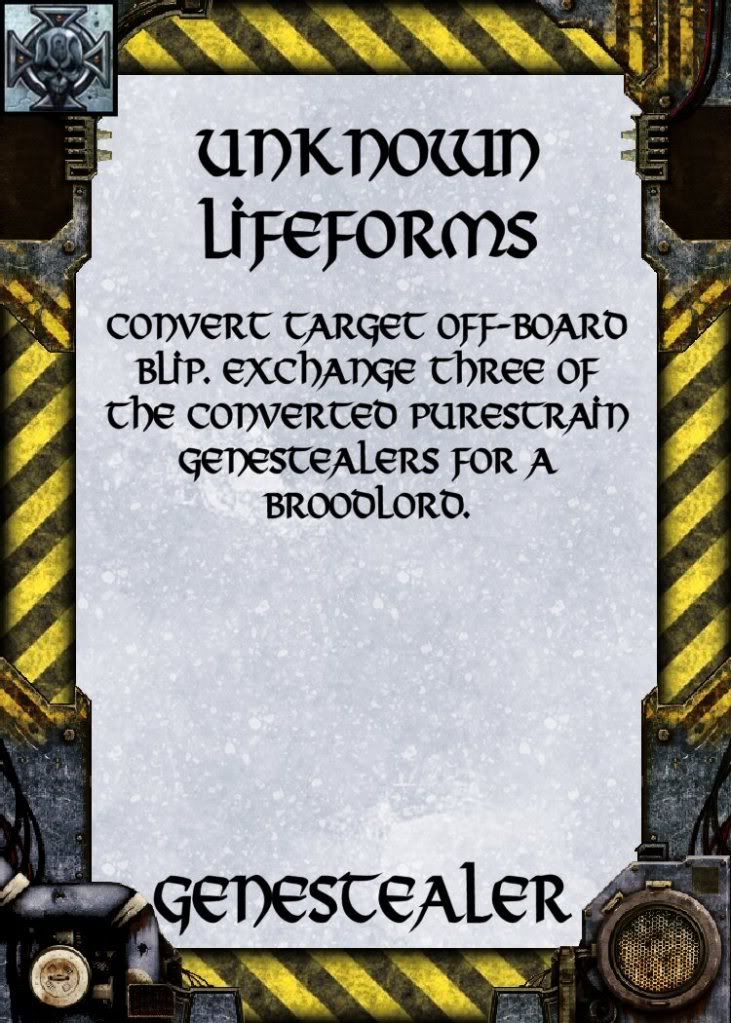
Finally, some of the cards included allow for some unique circumstances that shake up a mission, but in such a way as to remain balanced. “Unknown Lifeforms” allows you to swap three Purestrain Genestealers for a Broodlord, but requires that you do so as a blip enters the board. This allows for a large, powerful siege-breaker of a model, but gives the Marine player time to prep for its arrival. (Note this is not the third edition Broodlord, however. The shooting and melee rules for that one are silly, and will be discussed more at a later date. Think 1st edition Patriarch or so.)


Action cards are not something that a player can build a game-winning strategy around just by drawing, but they are something to help you on your way if you’re lucky and clever enough.

Coming on Friday: combat and dealing damage in Space Hulk: XT.

-M

Monday, June 11, 2012

Designer Diary: Overview of Space Hulk: XT


The purpose of this series of blog posts (Designer Diaries) is to give the world a look into the thought process behind my works. Over the years, there have been three official permutations of the Space Hulk board game. In addition to this, a number of added rules have been included in magazines, and numerous fan-made variants have also been made public. Several similar games have also been published by other companies.

Space Hulk: XT is my attempt to sort through all of the extra (and in some cases, highly conflicting) rules, charts, tables, units, weapons and missions that have appeared over more than two decades of Space Hulk. Ideally, the finished product will take what is best from the various versions of the game and update it to modern gameplay standards without modifying the core of gameplay any more than is necessary. Therein, however, resides the problem.

What are the “best” elements from each version of Space Hulk? If I simply make a cut-and-paste Frankenstein’s monster of a game based on what I deem to be “best,” there is little incentive for other players to view Space Hulk: XT as any more than another random variant. My goal, then, is not only to show what elements I have chosen to work with, but why I am doing so. Some game elements I find unnecessarily cumbersome, others simply do not seem to fit within the desired balance of the game. As such, many of these elements will not be included. It is my hope that by showing the thought process behind these decisions, I will be better able to convince others of the validity of the points I am attempting to make, and the gameplay experience that I am attempting to craft.

Coming this Wednesday: action card/fog of war decks in Space Hulk: XT.

-M

Thursday, June 7, 2012

Back in the saddle again!

After a rather sudden change in jobs late last year, I found myself in the awkward position of not really being able to post "fan" created game content of my own online. I essentially was required to live with no presence on the internet for others to see. However, now that that chapter of life has resolved itself, I am stepping back into my old shoes and beginning down this path of excitement and adventure once more. Thus, I offer my sincerest apologies for the delay in content, but can assure you all that things are about to transform. And then roll out.

Schedule for upcoming weeks:

First and foremost, Space Hulk XT. The Action Card decks, tokens and rules will all be properly formatted into snappy-looking .pdfs with new graphics. Then they will be hosted in a manner which makes downloading them much simpler than having to jump through fileshare hoops.

Following closely on the heels of the updated Action Card sets, I will begin posting previews of the updated XT Stat Cards for Marines and 'Stealers.

As the updated rules structure progresses (which includes the Stat Cards), be on the lookout for a series of Designer Diary posts explaining not only what I am building, but why I am doing it the way that I have chosen to do so.

Cheers,

-M

"I'm finding my back to sanity again, though I don't really know what I'm gonna do when I get there."

Wednesday, October 5, 2011

Gears Character Cards now on BGG

The character cards for Gears finally went through on BGG, huzzah!  Here's the link for them.

Extra cards on BGG